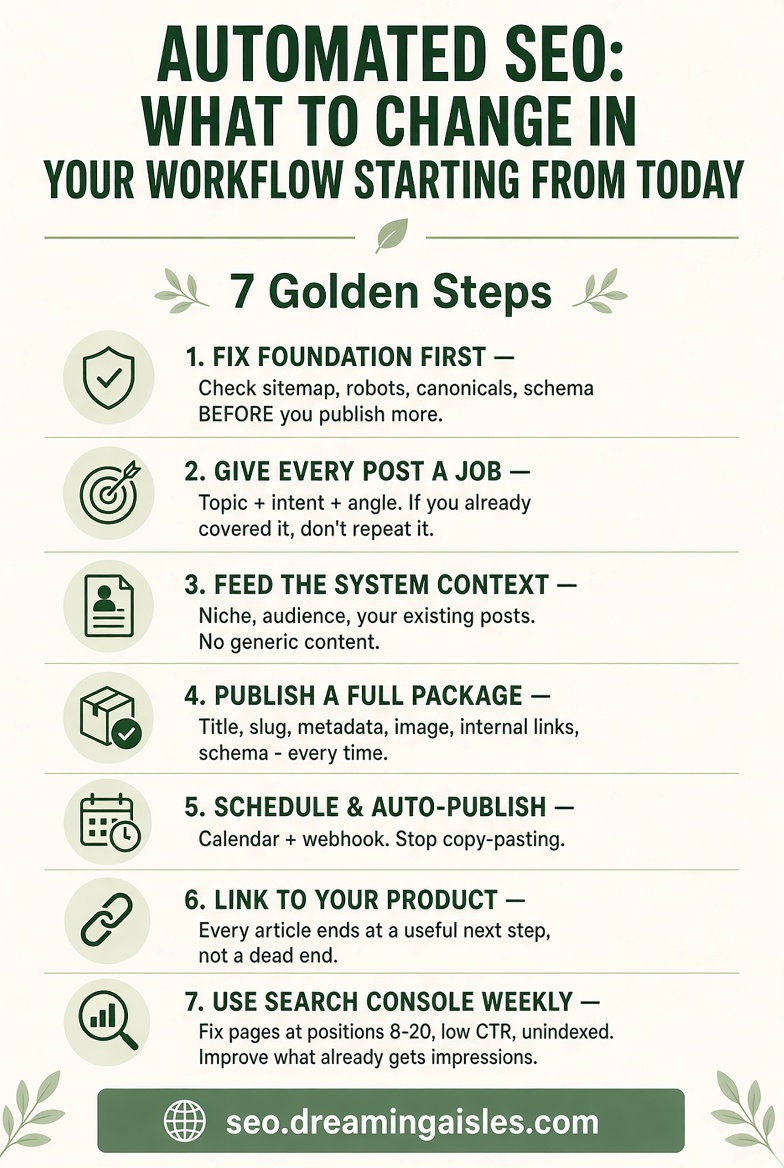
Don't chase one viral post. Fix the system. These are the seven changes to make in the workflow, starting today.
The 7 steps
- Fix the foundation first. Check the sitemap, robots.txt, canonicals and schema before you publish more.
- Give every post a job. Topic, intent and angle. If you already covered it, don't repeat it.
- Feed the system context. Niche, audience and your existing posts. No generic content.
- Publish a full package. Title, slug, metadata, image, internal links and schema, every time.
- Schedule and publish on a calendar. Use a calendar and a webhook. Stop copy-pasting the same fields between tools.
- Link to your product. Every article ends at a useful next step, not a dead end.
- Use Search Console weekly. Fix pages sitting around positions 8 to 20, pages with a low click rate, and pages that are not indexed. Improve what already gets impressions.
Why each step is worth doing
Fix the foundation first
Sitemap, robots.txt and canonical tags decide what a crawler is allowed to read, and which URL should be the one that counts. If those are wrong, new posts can sit unpublished in practice even after you press publish. Schema only helps when it matches the page you actually show. It can make a page eligible for a richer result. It does not guarantee one.
Give every post a job
Two pages aimed at the same query compete with each other. A topic, a search intent and an angle keep each URL distinct. If a post you already have does that job, improve that post instead of writing a second one.
Feed the system context
Generic text with no niche, no audience and no link back to your own pages is easy to skip. Useful pages carry something you actually know: the product, the customer, and the posts you have already published. A tool can draft faster. It cannot invent that context for you.
Publish a full package
A title, a clear slug, a meta description, a real image, internal links and schema belong in the same pass as the article. Leaving them for later means a cleanup queue. Do the package once, the same way, every time.
Schedule instead of copy-pasting
A content calendar plus a webhook moves a finished package from the draft to the site without retyping it. That cuts mistakes and keeps a rhythm you can keep. A regular schedule is an operations habit. It is not, by itself, a ranking promise.
Link to a useful next step
An article that ends with nowhere to go wastes the visit. Close on the product, the guide, or the check that fits the page. The link has to be useful to the reader, not a slogan dropped on the last line.
Use Search Console every week
Pages that already get impressions are the fastest place to work. Look for queries where you sit around positions 8 to 20, pages with impressions but a weak click rate, and URLs that are not indexed. Tighten the title, the answer and the internal links on those pages before you write something new.
Check the foundation on a live page
Run a free live audit at seo.dreamingaisles.com. It reads the live page and gives you a score, a letter grade, a fix list (fix first, fix next, nice to have) and a short roadmap. Re-check shows what changed. You can download or print the report. Reports stay in your browser. No account is needed. There are 10 free checks a day. There is no ranking promise.
More printables and ebooks are on the DreamingAisles shop. More articles are on the SEO blog.


