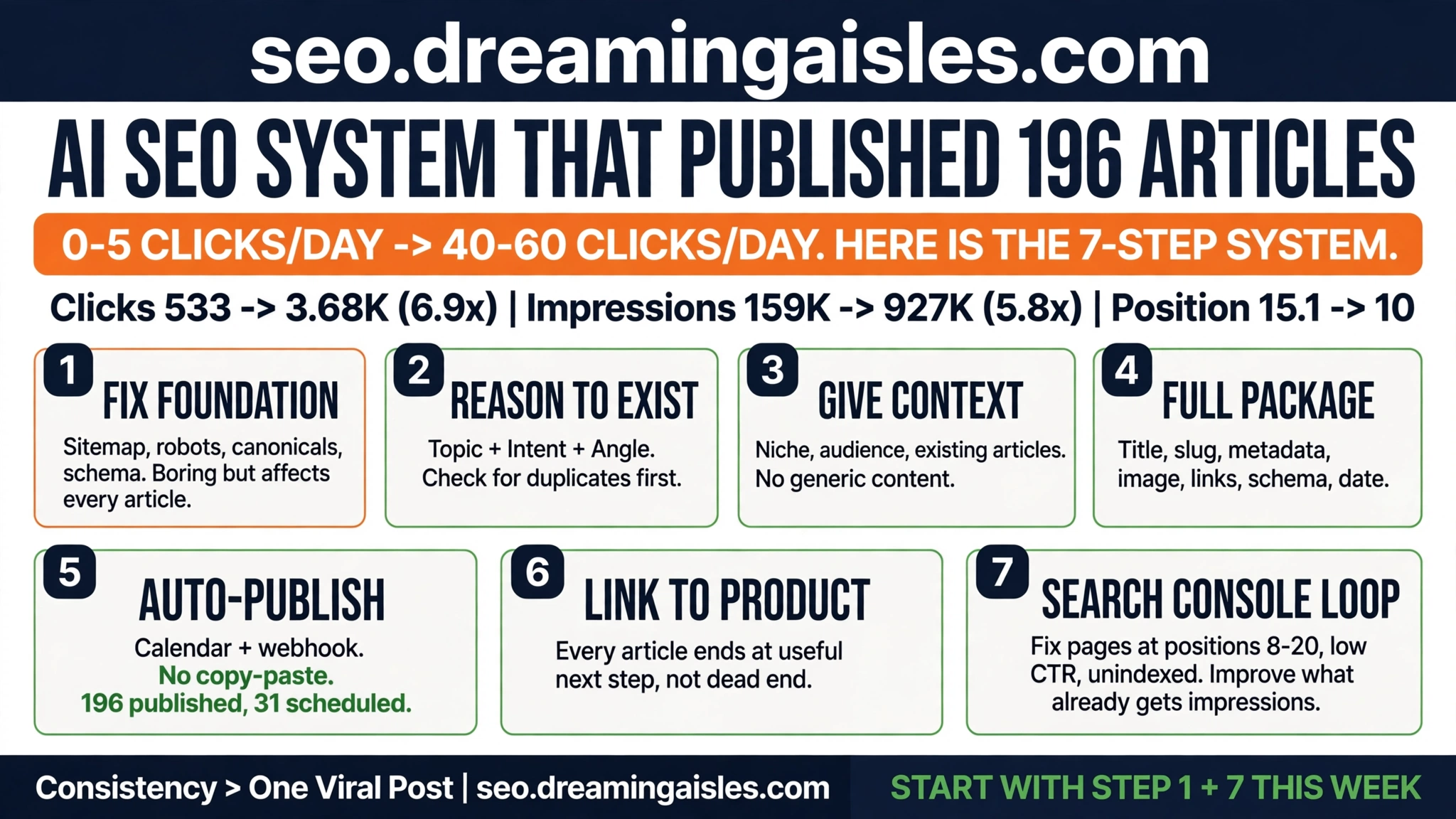
For months the graph was flat. Zero to five clicks a day. Search Console got checked too often. It was hard to tell whether the system was working, or just producing pages nobody would find.
Then it changed, slowly, without one viral post. These figures are the last six months compared with the six months before, on the site this system publishes to:
- Clicks: 533 to 3.68K (6.9x)
- Impressions: 159K to 927K (5.8x)
- Average position: 15.1 to 10
- Click rate: 0.3% to 0.4%
The site is now regularly on 40 to 60 clicks a day. No single article unlocked that. Many pages picked up a few clicks each, and those clicks compounded. The steps below are what that workflow did. They are a record of one site, not a promise that the next site will move by the same amount.
Where the clicks came from
A total can hide the useful part. Some clicks were people searching for the site by name. A growing share were strangers searching for something specific:
- "affiliate programs baking": 186 clicks
- "baking affiliate programs": 115 clicks
- "revolut affiliate program": 59 clicks
- "highest paying affiliate programs": 18 clicks
- "weight loss affiliate programs": 18 clicks
Those people had no reason to know the site existed. They found a page while looking for an answer. That is discovery traffic, not brand traffic.
The pipeline
At the time of writing, the queue looked like this:
- 196 published articles
- 31 scheduled
- 3 drafts
- 1 generating
- 124 ideas waiting
That pace would not have held if every article was pasted into a CMS by hand. The system is better at keeping a schedule than a person is. Consistency was the point.
Step 1. Get the technical foundation right
Automated publishing only helps when a crawler can find the page and tell which URL should count. Before you scale, check the sitemap, robots.txt, canonicals, metadata, schema, internal links and indexing. Every article needs a stable URL, links a crawler can follow, a correct canonical, and a place in the sitemap.
This part is boring. It also sits under every article published after it, so a small mistake gets expensive quickly.
This week: run a live check. If the foundation is broken, fix it before you publish more. Check your foundation free.
Step 2. Give every article a reason to exist
Asking for a hundred blog ideas produces the same broad topics again and again. Start with a specific topic, the search intent, the angle, and the page type. Ideas can come from searches people are already making, from gaps in what you have published, or from questions where another site is currently the one that answers.
Before an idea goes on the calendar, check whether the site already covers it. That cuts duplication, and it stops several articles chasing the same query. Choosing the topic takes more thought than generating the draft. A weak idea, run through a fast pipeline, just gets published faster.
Step 3. Give the system context about the site
The system needs the niche, the audience, and what already exists. On this project that meant affiliate programs, how commissions and cookies work, the networks, and the questions people ask before they join a program. It also needed the articles already on the site, so a new draft would not repeat them and could link to the right pages.
Better context produces an article that belongs on the site. Weak context produces generic advice that could sit on any marketing blog.
A useful instruction names the pages you already have, the reader, the decision they are trying to make, the URLs to link, and the topic not to repeat. "Write about affiliate programs" is not enough.
Step 4. Generate the complete article package
The output is more than the body. Each item can include the title, slug, search intent, angle, structure, metadata, featured image, internal links, schema and publication date. The article and the publishing details stay in the same pass.
Still review the direction, and spot-check what comes out. When the same problem shows up on several articles, change the shared instructions. Do not patch every article by hand.
Step 5. Schedule and publish automatically
This is the part that made the system useful day to day. Once an article is ready, it goes on the calendar and publishes through a webhook. No copying into another CMS, no formatting it again, no manual deploy. That is how 196 articles got published: a calendar, not a burst of motivation.
Step 6. Connect the content to the actual website
An article should end at a useful next page. A guide to high-paying programs can point at the matching listings. A post for bloggers can point at programs that fit that reader. A post about one company can point at that company's program page.
The reader gets a next step, and the site gets internal links that come from the article itself. It also stops the blog becoming a pile of pages that bring a visit and then stop.
Open your last five posts. If one of them does not end on a useful next page, fix that before you automate more publishing.
Step 7. Use Search Console as the feedback loop
Publishing is only half of the system. In Search Console, look for:
- Pages with impressions and few clicks
- Queries sitting between positions 8 and 20
- Articles competing for similar searches
- Crawled pages that are still not indexed
- Titles with a weak click rate
An average position of 10 means a lot of pages are close. The click rate on this site is still 0.4%, so titles and intent still have room. Improving pages that already get impressions is worth more than adding another hundred ideas to the calendar.
If you only do two steps this week, do step 1 and step 7.
What still requires you
The system can draft, fill in metadata, schedule and publish. A person still chooses the direction, reviews ideas, checks facts, and decides whether the page is useful. Automation takes the repetitive work. Judgment still decides what is worth publishing.
To be honest
Several things changed in the same period. Technical SEO was improved. The publishing pipeline was connected. Publishing became regular. The domain also got older, existing pages picked up more impressions, and Google had more time with the site.
The growth most likely came from those things together. There was not one article, or one switch, that unlocked it.
In short
An approved idea goes in. The system drafts the article and the SEO fields around it, puts it on a calendar, and publishes it to the site. Over the last six months that site recorded 3.68K clicks and 927K impressions, against 533 clicks and 159K impressions in the six months before.
Start here
Do not try to build all seven steps today. This week, check the foundation. Then open Search Console, filter positions 8 to 20, and improve five titles. Build the rest after that.
A free live audit reads the page you paste and returns a score, a letter grade, and a fix-first list: seo.dreamingaisles.com. The report stays in the browser. There is no ranking promise.


